Showing posts with label brain. Show all posts

September 26, 2012

Using Precisely-Targeted Lasers, Researchers Manipulate Neurons in Worms' Brains and Take Control of Their Behavior.

*Source: Science Daily


ScienceDaily (Sep. 23, 2012) — In the quest to understand how the brain turns sensory input into behavior, Harvard scientists have crossed a major threshold. Using precisely-targeted lasers, researchers have been able to take over an animal's brain, instruct it to turn in any direction they choose, and even to implant false sensory information, fooling the animal into thinking food was nearby.
 
 As described in a September 23 paper published in Nature, a team made up of Sharad Ramanathan, an Assistant Professor of Molecular and Cellular Biology, and of Applied Physics, Askin Kocabas, a Post-Doctoral Fellow in Molecular and Cellular Biology, Ching-Han Shen, a Research Assistant in Molecular and Cellular Biology, and Zengcai V. Guo, from the Howard Hughes Medical Institute were able to take control of Caenorhabditis elegans -- tiny, transparent worms -- by manipulating neurons in the worms' "brain."
The work, Ramanathan said, is important because, by taking control of complex behaviors in a relatively simple animal -- C. elegans have just 302 neurons -we can understand how its nervous system functions..
"If we can understand simple nervous systems to the point of completely controlling them, then it may be a possibility that we can gain a comprehensive understanding of more complex systems," Ramanathan said. "This gives us a framework to think about neural circuits, how to manipulate them, which circuit to manipulate and what activity patterns to produce in them ."
"Extremely important work in the literature has focused on ablating neurons, or studying mutants that affect neuronal function and mapping out the connectivity of the entire nervous system. " he added. "Most of these approaches have discovered neurons necessary for specific behavior by destroying them. The question we were trying to answer was: Instead of breaking the system to understand it, can we essentially hijack the key neurons that are sufficient to control behavior and use these neurons to force the animal to do what we want?"

Before Ramanathan and his team could begin to answer that question, however, they needed to overcome a number of technical challenges.

Using genetic tools, researchers engineered worms whose neurons gave off fluorescent light, allowing them to be tracked during experiments. Researchers also altered genes in the worms which made neurons sensitive to light, meaning they could be activated with pulses of laser light.

The largest challenges, though, came in developing the hardware necessary to track the worms and target the correct neuron in a fraction of a second.

"The goal is to activate only one neuron," he explained. "That's challenging because the animal is moving, and the neurons are densely packed near its head, so the challenge is to acquire an image of the animal, process that image, identify the neuron, track the animal, position your laser and shoot the particularly neuron -- and do it all in 20 milliseconds, or about 50 times a second. The engineering challenges involved seemed insurmountable when we started. But Askin Kocabas found ways to overcome these challenges"

The system researchers eventually developed uses a movable table to keep the crawling worm centered beneath a camera and laser. They also custom-built computer hardware and software, Ramanathan said, to ensure the system works at the split-second speeds they need.

The end result, he said, was a system capable of not only controlling the worms' behavior, but their senses as well. In one test described in the paper, researchers were able to use the system to trick a worm's brain into believing food was nearby, causing it to make a beeline toward the imaginary meal.

Going forward, Ramanathan and his team plan to explore what other behaviors the system can control in C. elegans. Other efforts include designing new cameras and computer hardware with the goal of speeding up the system from 20 milliseconds to one. The increased speed would allow them to test the system in more complex animals, like zebrafish.

"By manipulating the neural system of this animal, we can make it turn left, we can make it turn right, we can make it go in a loop, we can make it think there is food nearby," Ramanathan said. "We want to understand the brain of this animal, which has only a few hundred neurons, completely and essentially turn it into a video game, where we can control all of its behaviors."

Funding for the research was provided by the Human Frontier Science Program, the NIH Pioneer Award and the National Science Foundation.

August 18, 2012

'Mind-Control' Gaming Devices Leak Brain Data That Help Researchers Guess Users' Secrets

*Source: Forbes


The budding field of brain-machine interfaces promises a science-fictional future where games, computer operating systems, and prosthetics can be controlled with thought alone. But a new study shows that connecting minds to machines could let sensitive private information leak out along with those mental commands.

At the Usenix security conference in Seattle last week, a group of researchers from the University of California at Berkeley, Oxford University and the University of Geneva presented a paper (PDF here) that hints at the darker side of a future where brain sensors are used to let thoughts manipulate computers as fluidly as a mouse. In a study of 28 subjects wearing brain-machine interface devices built by companies like Neurosky and Emotiv and marketed to consumers for gaming and attention exercises, the researchers found they were able to extract hints directly from the electrical signals of the test subjects’ brains that partially revealed private information like the location of their homes, faces they recognized and even their credit card PINs.

“These devices have access to your raw EEG [electroencephalography, or electrical brain signal] data, and that contains certain neurological phenomena triggered by subconscious activities,” says Ivan Martinovic, a member of the faculty in the department of computer science at Oxford. “So the central question we were asking with this is work was, is this is a privacy threat?”

In their experiments, the researchers first showed users wearing the mind-control headsets a series of known images and numbers to measure what a moment of recognition looked like in their EEG data–they write that they sought out a signal known as the P300 response, a electrical spike that typically appears close to 300 milliseconds after a stimulus the subject recognizes.

Then they showed the subjects a series of test images and numbers and looked for those same signals. In a collection of unknown faces, for instance, they found a significant spike in the EEG data for a picture of Barack Obama that revealed the test subjects’ recognition of the president’s face. When shown a collection of locations on maps that included one of their home, the headset-wearers’ brains emitted tell-tale hints that allowed the experimenters to determine their home’s general location with 60% accuracy on the first try among a collection of ten choices. And when the subjects were asked to memorize a four-digit PIN and then shown a series of random numbers, the researchers found they could guess which of those random numbers was the first digit in the PIN with about 30% accuracy on the first try–far from a home run, but a significantly higher success rate than a random guess.

In fact, none of those results point to a realistic possibility of cybercriminals reading victims’ minds through their gaming headsets any time soon, Oxford’s Martinovic admits. The Neurosky and Emotiv devices, which sell for between $200 and $300, have hardly entered the mainstream, and the mind-reading attacks the researchers describe aren’t reliable enough to make them a profitable avenue for data theft, anyway.

But Martinovic says that the main challenge in looking for signs of the users’ mental responses was sorting through the noisy and often inaccurate signals the headsets produced. Those signals are likely to improve. A Brown University researcher has already shown that paralyzed users with surgically implanted brain sensors can wield fine-grain software controls, and a University of Pittsburgh study showed that monkeys could successfully feed themselves with a mind-controlled robotic arm.

As the technology develops, keeping private information from mixing with those user commands may become tougher, he says. “We believe that these things are going to improve,” Martinovic says. “A more accurate signal is important for both a legitimate user and the attacker…The tradeoff will be whether you can protect the user from an attack and still have a good signal.”

It’s also important to note that for the data theft the researchers imagine to work, the snoop trying to read users’ brain signals would need access to both the headset and the images on the screen in front of them. But given that Neurosky’s and Emotiv’s devices both already have APIs that allow third-party developers to write programs that use the devices, it’s not hard to imagine an application that tricks users into thinking about private information that’s then revealed through their brains’ electrical signals, says computer science professor Dawn Song, whose group at Berkeley led the research.

“In this threat model, the attacker doesn’t need to compromise anything,” Song says. “He simply embeds the attack in an app, such as a game using [brain-machine interface] that the user downloads and plays. In this case, the malicious game designs and knows the visual stimuli the user is looking at and also gets the brain signal reading at the same time.”

Even then, admits Martinovic, the attacker would need to surreptitiously trick the user’s brain into calling up whatever data he or she hoped to steal. “The challenge would be to get users to think about their sensitive information,” he says. “But social engineering could make that possible. Attackers are creative.”

Read the researchers’ full paper below.


On the Feasibility of Side-Channel Attacks with Brain-Computer Interfaces

November 2, 2011

Invasion Of The Mind-Controlling Zombie Parasites

*Source: NPR


Centers for Disease Control and Prevention
Toxoplasma gondii is a parasite, seen here in brain tissue, that can alter the behavior of the host. It can make rodents attracted to cats, leaving them vulnerable to getting eaten.

A few months back, something terrible happened to millions of flies around Washington, D.C.

"We were getting literally hundreds of reports of these crazy dead flies everywhere — on vegetation, on sign posts," says Mike Raupp, an entomologist at the University of Maryland.

He says the flies were attacked by a mind-controlling fungus.

"It basically zombie-izes them. In other words, it manipulates their behavior," Raupp says. "[The fly] moves to a high point, let's say the tip of a blade of grass."

The fly freezes at the tip of the leaf, and the fungus spews more mind-controlling spores into the wind.

Mind-controlling parasites are all around us. The number of creatures that can be affected is "huge," says Janice Moore, a professor at Colorado State University who wrote a book on parasites and animal behavior. She says some parasites play with neurotransmitters; others with hormones.

"If you take the world of parasites broadly, we don't know the half of it yet," she says.

Parasites can be terrifyingly precise. One example that's becoming a little more understood is Toxoplasma gondii.

"Toxoplasma basically makes rodents somewhat fearless around cats — in fact, it's even more than fearless," Moore says. "There's some evidence that they're attracted to the smell of cats and to cat urine."

What happens to rats that like cats? They get eaten.

On his laptop, Raupp plays a video from a lab in France. It shows giant worms exploding out of a dying cricket that's floating in a swimming pool. He says small organisms called hairworms begin to reach maturity inside the cricket. Then they make the cricket start to act erratically.

"Crickets that would normally kind of move pretty slowly and stay in dimly lit areas actually become attracted to light," he says. "What this does apparently is bring them out of their normal habitat and increase the likelihood they're going to bump into a pond. Once they reach the edge of that water, they take the suicidal plunge into the water."

That's when the hairworms leave the host and reproduce.

Humans aren't necessarily immune to parasites' powers, either.

"Studies have looked at accidents — individuals in automobile accidents, both actually drivers and pedestrians — and they have increased rates of Toxoplasma as well," says Bob Yolken, chair of Pediatric Neurovirology at Johns Hopkins medical school.

The link is nowhere near conclusive, but still, Moore says it's enough to make you think.

"I do think about free will some because I do think about how we're all trapped in our own skins," she says, "and to tell you the truth, free will in general, it always amazes me how in the same situation some people will rise to the occasion and be saints and other people will be sinners."

Many things affect that, Moore says, but we may have to add parasites to the list.

Fungus Causes Cricket Suicide

October 25, 2011

The Brain Numbing Effects of Fluoride.

Fluoride


Another source of harmful chemicals is found in the modern man’s water supplies and soft drinks. As of 2002, the CDC statistics show that almost 60% of the U.S. population receives fluoridated water through the taps in their homes. The official reason for the presence of fluoride in our tap water? It prevents tooth decay. Ok … really? Is this mildly important benefit worth the consuming of great amounts of this substance by the population? Some studies even denied the dental benefits of fluorided water.
“Scientists now believe that the main protective action from fluoride does not come from ingesting the chemical, with the teeth absorbing it from inside the body, but from direct absorption through topical application to teeth. This means swallowing water is a far less effective way to fight cavities than brushing with fluoridated toothpaste.”
- Source
So why is fluoride still found in tap water? Here are some quick facts about fluoridation chemicals:
  • they were once used as pesticides
  • they are registered as “poisonous” under the 1972 Poisons Act, in the same group of toxins as arsenic, mercury and paraquat
  • fluoride is scientifically classed as more toxic than lead, but there is about 20 times more fluoride than lead in tap water
Many studies have been conducted on the effects of fluoride on the human body and some notable adverse effects have been noted: it changes bone structure and strength, impairs the immune system and it was linked to some cancers. Another alarming consequence of fluoridation is its effects on brain functions:
“In 1995, neurotoxicologist and former Director of toxicology at Forsyth Dental Center in Boston, Dr. Phyllis Mullenix published research showing that fluoride built up in the brains of animals when exposed to moderate levels. Damage to the brain occured and the behavior patterns of the animals was adversely effected. Offspring of pregnant animals receiving relatively low doses of fluoride showed permanent effects to the brain which were seen as hyperactivity (ADD-like symptoms). Young animals and adult animals given fluoride experienced the opposite effect — hypoactivity or sluggishness. The toxic effects of fluoride on the central nervous system was subsequently confirmed by previously-classified government research. Two new epidemiological studies which tend to confirm fluoride’s neurotoxic effects on the brain have shown that children exposed to higher levels of fluoride had lower IQs.”
- Source

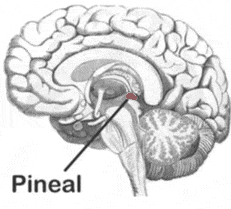
A lesser known, but extremely important side effect of fluoride is the calcification of the pineal gland.

Up until the 1990s, no research had ever been conducted to determine the impact of fluoride on the pineal gland – a small gland located between the two hemispheres of the brain that regulates the production of the hormone melatonin. Melatonin is a hormone that helps regulate the onset of puberty and helps protect the body from cell damage caused by free radicals.
It is now known – thanks to the meticulous research of Dr. Jennifer Luke from the University of Surrey in England – that the pineal gland is the primary target of fluoride accumulation within the body.
The soft tissue of the adult pineal gland contains more fluoride than any other soft tissue in the body – a level of fluoride (~300 ppm) capable of inhibiting enzymes.
The pineal gland also contains hard tissue (hyroxyapatite crystals), and this hard tissue accumulates more fluoride (up to 21,000 ppm) than any other hard tissue in the body (e.g. teeth and bone).
- Source
Other than regulating vital hormones, the pineal gland is known to serve an esoteric function. It is known by mystic groups as the “third eye” and has been considered by many cultures to be part of the brain responsible for spiritual enlightenment and the “link to the divine”. Is enlightenment out of bounds for the modern man?
“In the human brain there is a tiny gland called the pineal body, which is the sacred eye of the ancients, and corresponds to the third eye of the Cyclops. Little is known concerning the function of the pineal body, which Descartes suggested (more wisely than he knew) might be the abode of the spirit of man.”
– Manly P. Hall, The Secret Teachings of All Ages